Mara
A builder who wants to save the workshop. Quick to try an idea; learning to test it.
Every place has a story. Every claim needs evidence.
Begin the story →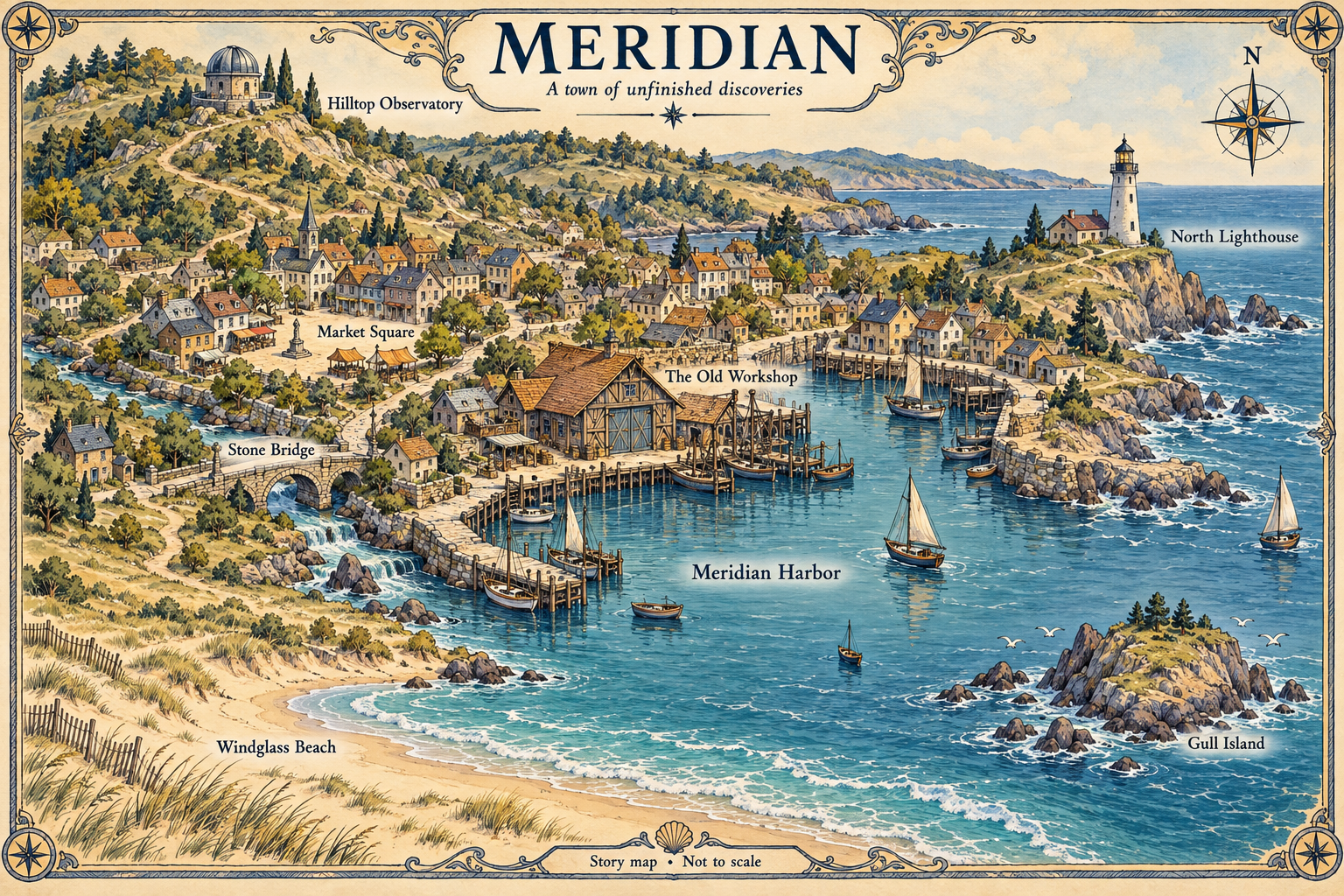
Choose a place above. The adventure begins at the Old Workshop.
1.1 The Room That Wasn’t There · 1.2 A Shape Can Change · 1.3 Half the Evidence · 1.4 The Cabinet’s Outline · 1.5 A Box of Records · Checkpoints
The workshop was supposed to be empty by Friday.
Mara thought this was a terrible idea. Most of the town’s good ideas had started there, and several of its terrible ideas had at least become interesting machines.
She pushed open the broad wooden doors. Behind her, Eli carried a notebook, Tess carried the inventory list, and Jun carried a sandwich.
“You were supposed to bring something useful,” Tess said.
“I’m planning ahead.”
Their assignment was simple: record what remained before the town decided what to keep.
Eli found a floor plan beneath a cracked drawing board. Tess unfolded the survey made last week. Both showed the front doors, the long workbench, and the windows facing the harbor.
But the rooms were different.
“Someone moved a wall,” Mara said.
“Maybe,” Eli replied.
Jun leaned over his shoulder. “Or someone drew it wrong.”
Tess cleared a space on the table. “Before we accuse a dead mapmaker of being bad at maps, could we check?”
On the older plan, a narrow room occupied the back corner. In the workshop, that corner was behind a solid wall.
Your task: compare the records. What can the measurements establish—and what still needs checking?
Examine the evidence →Both records show the same outer rectangle: 10 m by 8 m. The old plan identifies a back room measuring 4 m by 3 m. The current survey marks that corner as inaccessible.
Old record: both rooms are identified. Dimensions are labeled; do not measure the drawing.
A 6 m × 8 m rectangle on the left and a 4 m × 5 m rectangle on the lower right cover the main workspace without overlap.
Use graph paper for diagrams and calculations. Label your page “1.1 — Area and Evidence.”
This page does not save or submit responses. Keep your work on graph paper.
Area measures how much two-dimensional space a region covers. Rectangle area = length × width. Multiplying meters by meters gives square meters, written m².
For a composite shape, add the areas of non-overlapping pieces or subtract a missing piece from a larger shape. Both methods must describe the same region.
Another example: a 9 m × 7 m rectangle with a 2 m × 3 m corner removed has area 63 − 6 = 57 m².
1. A rectangular garden measures 12 m by 7 m. A 3 m by 2 m corner is reserved for a path. Find the planting area.
2. Draw two different rectangles with an area of 24 square units. Do their perimeters match?
3. A student says equal floor areas prove two rooms have the same shape. Give a counterexample.
1. 78 m². 2. For example, 4 × 6 and 3 × 8 have perimeters 20 and 22 units. 3. Those same rectangles have equal areas and different shapes.
“Twelve square meters,” Eli said. “That’s what the old plan puts in the corner.”
“So there’s a room?” Mara asked.
Tess shook her head. “There’s a record of a room. We still need to check the record.”
Jun turned the old sheet over. In the margin, beneath a smear of blue ink, someone had written: “Check the wall beside the harbor window.” They had their next place to look.
A builder who wants to save the workshop. Quick to try an idea; learning to test it.
A careful mapmaker. Loves exact records; learning to work with uncertainty.
A skeptical investigator with a sense of humor. Asks questions; learning to support his claims.
An organizer who makes room for everyone. Turns disagreements into questions the group can investigate.